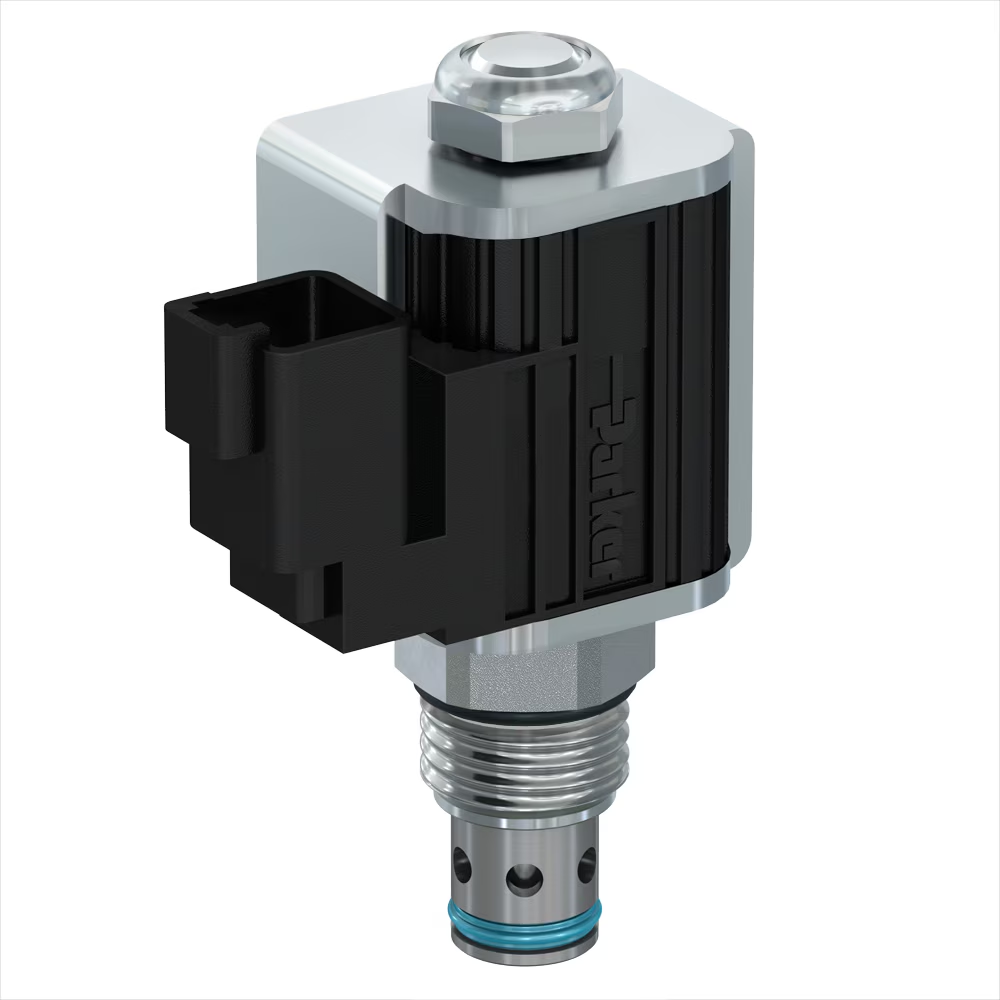
2 Way Poppet Type Solenoid Valve - DSH101CR
SKU:
DSH101CR
In Stock (15 items)
660 views
Product Summary
GLOBAL - Parker’s 2-way poppet solenoid valves check flow in one direction free flow opposite; normally-open or normally-closed configurations available. Capable of pressures up to 350 bar (5000 psi)...
Product Description
GLOBAL - Parker’s 2-way poppet solenoid valves check flow in one direction free flow opposite; normally-open or normally-closed configurations available. Capable of pressures up to 350 bar (5000 psi) and flows up to 260 lpm (70 gpm). Low leakage
Parker’s 2-way poppet style solenoid valves feature a proven design that ensures very low leakage when flow is blocked in one direction and minimized pressure drop in the free flow position. These valves can operate with hydraulic system flows as high as 260 lpm and pressures up to 350 bar with normally-open or normally closed configurations available. Parker’s 2-way poppet solenoid valves are ideal for unloading and load holding applications that require low poppet style leakage within mobile, industrial, or manufacturing markets._x000D_
_x000D_
Markets:_x000D_
• Aerial_x000D_
• Construction_x000D_
• Material Handling_x000D_
• Miscellaneous Industrial_x000D_
• Miscellaneous Manufacturing_x000D_
• Miscellaneous Mobile_x000D_
_x000D_
Features & Benefits:_x000D_
• Replaceable one-piece coils with low amp draw_x000D_
• Fast response available_x000D_
• Manual override options_x000D_
• Low leakage spherical poppet_x000D_
• All external parts zinc plated_x000D_
_x000D_
Applications:_x000D_
• Unloading circuits_x000D_
• Load holding applications_x000D_
• Lift circuits_x000D_
_x000D_
Additional Technical Insight:_x000D_
Parker’s 2 way poppet valves are pilot operated, low leakage solenoid actuated valves. Similar to a check valve, these valves will block flow in one direction will very low leakage (5 drops per minute, or less). When actuated, these valves allow flow to pass through the valve. These valves are typically selected due to their low leakage characteristics and their ability to meet higher flow requirements. Poppet valves are often used on single operation actuators or in unloading functions. They are available in normally closed and normally open types with fast response versions available._x000D_
_x000D_
Parker’s two way, two position poppet valves consist of a main poppet, a pilot piston, a spring, and a solenoid coil. _x000D_
_x000D_
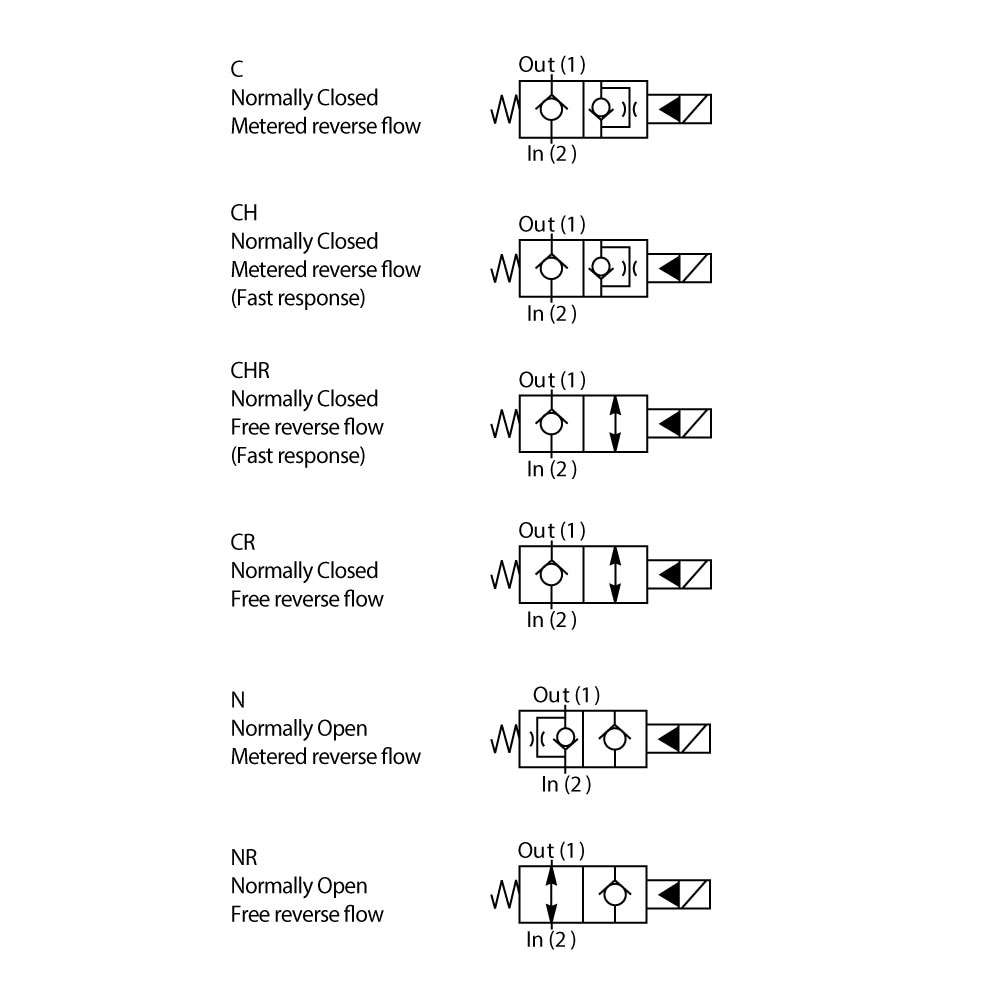
The normally closed poppet version of these valves will act as a check valve when the valve is de-energized. This blocks flow in both directions while allowing free flow in the reverse direction. When the coil is energized, the poppet is piloted open (lifts) and allows free flow in the previously checked direction, typically from the side of the cartridge out the nose._x000D_
_x000D_
The normally open poppet version of these valves, when the coil is de-energized, will allow free flow from the side port of the valve (port 2) out the nose of the valve (port 1). Energizing the coil shifts the poppet to block flow in both directions._x000D_
_x000D_
Operation: The normally closed poppet valve is held on its seat by a spring, blocking the pilot flow. This will allow pressure at the inlet port (port 2) to hold the poppet on its seat preventing flow through the valve (port 2 to port 1)._x000D_
_x000D_
If the nose of the cartridge (port 1) is pressurized enough to overcome the spring force, and pushing the poppet off of its seat, flow will be allowed through port 1 to port 2. When the coil is energized, the pilot poppet is lifted off of its seat, venting the pressure inside the poppet to port 1. This creates a pressure imbalance across the main poppet, therefore lifting the poppet and allowing flow from the side to the nose (2 to 1). Because these valves are pilot operated, a minimal amount of pressure differential is necessary (25-50 psi), along with flow between ports 2 and 1 must be present to overcome the spring and lift the poppet._x000D_
_x000D_
The normally open valve pilot is held off its seat by spring force. Pilot flow is vented to port 1, creating a pressure imbalance that moves the main poppet. This differential lifts the poppet allowing flow from the side to nose (2 to 1). Since poppet valves are pilot operated, a minimum amount of pressure differential (25-50 psi) between ports 2 overcomes the spring force to drive the valve pilot and main poppet into their seats, thus blocking flow from port 2 to 1. If the nose of the cartridge (port 1) is pressurized, the pressure will overcome the spring force and solenoid force, pushing the poppet off of its seat, allowing restricted flow through the cartridge (1 to 2).
_x000D_
Markets:_x000D_
• Aerial_x000D_
• Construction_x000D_
• Material Handling_x000D_
• Miscellaneous Industrial_x000D_
• Miscellaneous Manufacturing_x000D_
• Miscellaneous Mobile_x000D_
_x000D_
Features & Benefits:_x000D_
• Replaceable one-piece coils with low amp draw_x000D_
• Fast response available_x000D_
• Manual override options_x000D_
• Low leakage spherical poppet_x000D_
• All external parts zinc plated_x000D_
_x000D_
Applications:_x000D_
• Unloading circuits_x000D_
• Load holding applications_x000D_
• Lift circuits_x000D_
_x000D_
Additional Technical Insight:_x000D_
Parker’s 2 way poppet valves are pilot operated, low leakage solenoid actuated valves. Similar to a check valve, these valves will block flow in one direction will very low leakage (5 drops per minute, or less). When actuated, these valves allow flow to pass through the valve. These valves are typically selected due to their low leakage characteristics and their ability to meet higher flow requirements. Poppet valves are often used on single operation actuators or in unloading functions. They are available in normally closed and normally open types with fast response versions available._x000D_
_x000D_
Parker’s two way, two position poppet valves consist of a main poppet, a pilot piston, a spring, and a solenoid coil. _x000D_
_x000D_
The normally closed poppet version of these valves will act as a check valve when the valve is de-energized. This blocks flow in both directions while allowing free flow in the reverse direction. When the coil is energized, the poppet is piloted open (lifts) and allows free flow in the previously checked direction, typically from the side of the cartridge out the nose._x000D_
_x000D_
The normally open poppet version of these valves, when the coil is de-energized, will allow free flow from the side port of the valve (port 2) out the nose of the valve (port 1). Energizing the coil shifts the poppet to block flow in both directions._x000D_
_x000D_
Operation: The normally closed poppet valve is held on its seat by a spring, blocking the pilot flow. This will allow pressure at the inlet port (port 2) to hold the poppet on its seat preventing flow through the valve (port 2 to port 1)._x000D_
_x000D_
If the nose of the cartridge (port 1) is pressurized enough to overcome the spring force, and pushing the poppet off of its seat, flow will be allowed through port 1 to port 2. When the coil is energized, the pilot poppet is lifted off of its seat, venting the pressure inside the poppet to port 1. This creates a pressure imbalance across the main poppet, therefore lifting the poppet and allowing flow from the side to the nose (2 to 1). Because these valves are pilot operated, a minimal amount of pressure differential is necessary (25-50 psi), along with flow between ports 2 and 1 must be present to overcome the spring and lift the poppet._x000D_
_x000D_
The normally open valve pilot is held off its seat by spring force. Pilot flow is vented to port 1, creating a pressure imbalance that moves the main poppet. This differential lifts the poppet allowing flow from the side to nose (2 to 1). Since poppet valves are pilot operated, a minimum amount of pressure differential (25-50 psi) between ports 2 overcomes the spring force to drive the valve pilot and main poppet into their seats, thus blocking flow from port 2 to 1. If the nose of the cartridge (port 1) is pressurized, the pressure will overcome the spring force and solenoid force, pushing the poppet off of its seat, allowing restricted flow through the cartridge (1 to 2).
The Parker 2 Way Poppet Type Solenoid Valve - DSH101CR is an excellent solution for industrial applications. This solenoid valve controls flow in one direction while allowing free flow in the reverse direction, providing efficiency and reliability. With options for normally open or normally closed configurations, it offers flexibility to meet various user needs. Capable of handling pressures up to 350 bar (5000 psi) and flow rates of 260 lpm (70 gpm), this device is ideal for high-performance systems. Its low leakage feature enhances system efficiency, while all parts being made of steel and operating components made of hardened steel ensure durability and longevity. Operating effectively in a temperature range of -35 °F (-37 °C) allows it to be safely used in diverse industrial environments. The Parker brand is known for providing solutions that comply with industry standards, reinforcing its reliability in the sector. This solenoid valve is commonly used in automation, hydraulic...
Technical Specifications
| Weight | 0.41 lb, 0.2 kg |
| Division | Hydraulic Valve Systems Division |
| Function | 2-way |
| Coil Type | 5/8" Super Coil |
| Flow Rate | 15 gal/min, 60 L/min |
| Leak Rate | 5 drops/min |
| Cavity Size | C10-2 |
| Body Material | N/A |
| Configuration | Normally Closed |
| Input Voltage | 85% of rated voltage at 72°F (20°C) min |
| Mounting Type | Screw in cartridge valve |
| Response Time | 80 ms |
| Seal Material | D-Ring (Standard) |
| Actuation Type | Electrical |
| Flow Direction | Side to Nose (2-1) |
| For Fluid Type | Mineral-based or synthetic hydraulic fluids |
| Operation Type | Solenoid operated |
| Valve Material | All parts steel. All operating parts hardened steel |
| Free Reverse Flow | Yes |
| Maximum Flow Rate | 15 gal/min, 60 L/min |
| Installation Torque | 51 to 55 lb-ft, 69 to 75 Nm |
| Adjustment Mechanism | N/A |
| Operating Temperature | -35 to +200 °F, -37 to +93 °C |
| Override Functionality | N/A |
| Filter Efficiency Rating | ISO 4406 18/16/13, SAE Class 4 |
| Wire Mesh Screen Included | No |
| Coil Nut Tightening Torque | 5 to 7 lb-ft, 7 to 10 Nm |
| Maximum Operating Pressure | 5000 psi, 350 bar |
| Maximum Kinematic Viscosity | 45-2000 SSU (6 to 420 cSt) |
| Maximum Inlet Pressure Rating | 5000 psi, 350 bar |
| Maximum Operating Temperature | +200 °F, +93 °C |
| Minimum Operating Temperature | -35 °F, -37 °C |
| Brand | Parker |
| Model | 2 Way Poppet Type Solenoid Valve - DSH101CR |
| SKU | DSH101CR |
| Main Category | Parker |
Shipping & Returns Information
Shipping Information
- Shipped within 2-3 business days
- Free shipping over 500 TL
- Insured shipping
Return & Exchange
- 14 days return right
- Return in original packaging
- Fast processing guarantee